
What it does
Radly.pro is intended as an educational and assistive tool for radiologists. It aims to reduce the administrative burden of proofreading while minimising “literacy errors” that could impact patient safety.
Note: The platform is designed for professional guidance; all AI-generated outputs require a final review by a qualified radiologist to ensure clinical accuracy.
The Evolution of Radiology Reporting and the Need for Advanced Detection
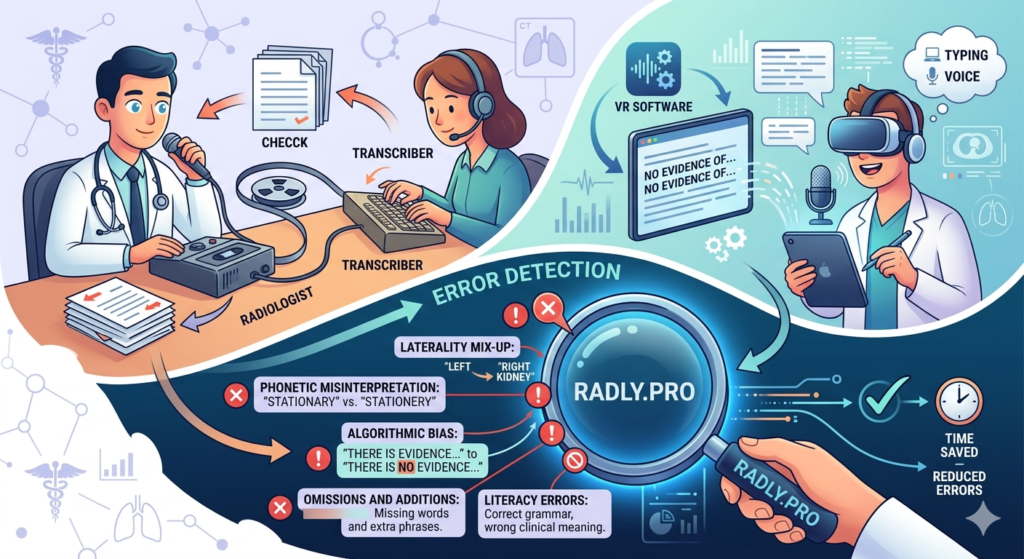
Historically, the workflow for radiology reporting was a manual, two-stage process: radiologists dictated their findings onto tape, which were then converted into text by medical transcribers before being returned to the clinician for final verification. The landscape shifted significantly with the introduction of Voice Recognition (VR) software, allowing reports to be transcribed by software in real-time. Today, clinicians utilize various methods, including VR, manual typing, or a hybrid of both.
However, each of these reporting methods is susceptible to a unique spectrum of errors. Traditional spell checkers often fail to detect these issues, as they frequently involve correctly spelled words used in the wrong context. Common pitfalls include:
- Phonetic Misinterpretation: Misunderstanding words that sound similar but have vastly different medical implications.
- Omissions and Additions: The accidental missing of words or the erroneous addition of new ones.
- Algorithmic Bias: VR software is trained on vast datasets and may become biased toward commonly used phrases. For instance, a system might incorrectly insert a “no” into the phrase “there is evidence of malignancy” simply because negative findings are statistically more common in its training data.
- Laterality and Literacy Errors: Radiologists may introduce “literacy errors” that, while grammatically and orthographically correct, pose critical clinical risks—such as a left-right laterality mix-up.
Radly.pro provides a specialised solution designed to detect these complex semantic and technical inconsistencies, helping radiologists reduce errors and save valuable time during the report-checking process.